
Why Jeans Are So Hard to Buy Online
Jeans are one of the trickiest things to buy online. Sizes vary between brands, a size 8 in one store fits like a 10 in another, and stretch, rise and cut all change how a pair feels on your body.
The good news is that a tape measure and a few minutes can take most of the guesswork out. This guide shows you exactly how to measure, how to read a size chart and what to do when you fall between sizes.
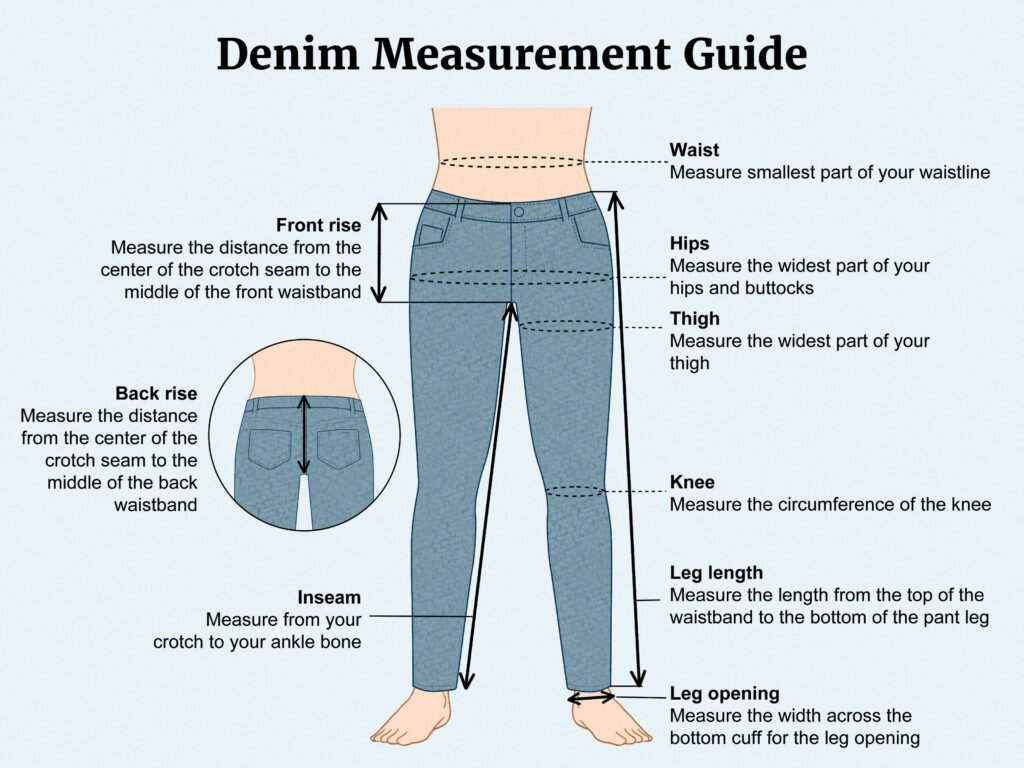
How to Measure Yourself for Jeans
You need a soft measuring tape, a mirror and a pair of thin, form-fitting clothes or underwear. Keep the tape snug but not tight, and stand naturally.
- Waist. Find the narrowest part of your torso, usually an inch or so above your belly button. Wrap the tape around it, keeping it level. For high-rise jeans, this is the number that matters most.
- Hips. Stand with your feet together and measure around the fullest part of your hips and seat. Check in the mirror that the tape is level all the way around.
- Inseam. Take a pair of pants that fit you well in length. Lay them flat and measure from the crotch seam straight down the inner leg to the hem. Measuring a pair you own is more accurate than measuring yourself.
- Rise (optional). On the same pair, measure from the crotch seam up to the top of the front waistband. This tells you which rise feels comfortable: roughly under 9 inches is low rise, 9 to 10 is mid rise and over 10 is high rise, though brands vary.
Write your numbers down in both inches and centimeters so you can compare them with any size chart.
How to Read a Size Chart
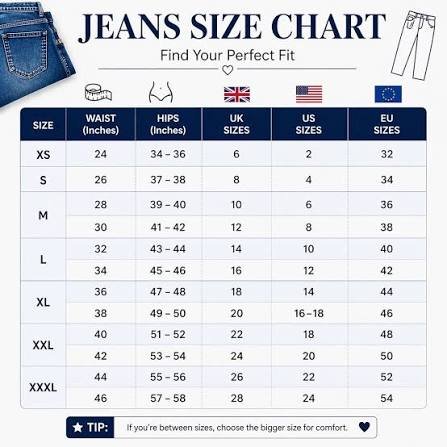
Every product page should have its own size chart. Always use the chart for that specific pair rather than the size you usually buy. Here is how to use it:
- Start with your hip measurement for mid- and low-rise jeans, and your waist measurement for high-rise jeans. These are usually the tightest points.
- Check whether the chart lists body or garment measurements. A body chart tells you which size fits your measurements; a garment chart gives the jeans’ actual flat dimensions, which are often smaller because of stretch.
- Look at the inseam options. Some styles come in petite, regular and tall lengths. Pick the one closest to your inseam.
As a rough starting point, many US women’s brands size close to this. Treat it as a general guide only and always confirm with the product’s own chart:
How Fabric and Stretch Affect Your Size
The fabric composition, listed on the product page, tells you a lot about fit:
- 100% cotton (rigid denim): little to no give. Choose the size that matches your measurements exactly, or size up if you are between sizes. Rigid denim softens slightly over time but won’t stretch much.
- Cotton with 1–2% elastane: comfortable stretch with good shape recovery. Most people take their usual size.
- Cotton with polyester and 2%+ elastane: very stretchy and form-fitting. These often relax with wear, so many shoppers pick the size that feels snug at first.
As a rule, the more stretch a pair has, the more it will give after a few hours of wear. If you like a close fit, the snugger size is usually the better choice in stretch denim.
Three More Ways to Get It Right
Compare With a Pair You Already Love
Lay your best-fitting jeans flat and measure straight across the waistband, then double it. Measure the hips the same way, about 7 inches below the waistband. If a size chart lists garment measurements, compare them directly with these numbers.
Read the Reviews Like a Pro
Customer reviews on the product page are one of the best fit tools available. Look for:
- Comments on whether the style runs small, large or true to size
- Reviewers who share your height, shape or usual size
- Mentions of length, waist gap and how the fabric feels after wearing
What to Do If You Are Between Sizes
- Fuller hips, smaller waist: size to your hips and choose a high rise with stretch, or wear a belt.
- Rigid denim: size up. It will not give much.
- Very stretchy denim: size down if you prefer a close fit.
- Still unsure: some shoppers order two sizes and return the one that doesn’t fit. Check the return terms on the product page first.
Fit Troubleshooting
Already tried a pair on? Use this table to work out what to change next time.
| Problem | Likely cause | What to try |
|---|---|---|
| Gap at the back of the waist | Hips are larger relative to waist | High rise with a contoured waistband, more stretch |
| Tight at the hips, loose at the waist | Size chosen by waist | Size to your hips; use a belt |
| Waistband digs in when sitting | Rise too low or waist too small | Mid or high rise; one size up |
| Fabric bunches at the ankle | Inseam too long | Petite or cropped length; check inseam |
| Wrinkles across the front of the hips | Too tight through the hip | One size up or a looser cut |
| Saggy seat after a few hours | Very stretchy fabric, size too big | One size down; lower-stretch denim |
FAQ
Should jeans be tight when you first try them on? Stretch jeans should feel snug but comfortable, since they usually loosen slightly with wear. You should be able to sit and bend without the waistband digging in.
Do jeans stretch after you buy them? Most stretch denim relaxes by about half a size with wear. Rigid 100% cotton denim changes much less.
Is jean size the same as waist size? Not always. Numeric US sizes (0, 2, 4 and so on) don’t equal your waist in inches. Some brands use waist sizing (26, 27, 28), which is closer, but always check the chart.
How do I know my inseam if I don’t have well-fitting pants? Stand barefoot against a wall and have someone measure from the top of your inner thigh down to the floor, then subtract an inch or so depending on the shoes you plan to wear.
Shop With Confidence
With your measurements in hand, a quick look at the size chart and a few minutes reading reviews, buying jeans online gets a lot less stressful.
Ready to find your fit? Browse the Flamingals collection on Amazon and check the size chart on each product page before you order.